Showing posts with label Coloring. Show all posts

Friday, April 17, 2015

What does your dad do?

My students were learning names of jobs and what people do, for instance, a police officer keeps our community safe, a firefighter puts out fires, a taxi driver drives around town, etc. After a few classes and significant practice, we wrapped this lesson up with a writing task in which they wrote about their parents´ jobs. We used an app called CHATTER PIX, which allows users to add a voice to a picture. No need to mention they had a blast! 


OPTION 2: Students draw themselves in the clothes of the professional they want to become when they grow up and write about it. They can explain their choice by using a reason or an adjective.

Examples:

When I grow up...

I want to be a doctor because I want to help sick people.
I want to be a vet because I love animals and I want to help sick animals.
I want to be an architect because I think it´s interesting/fun/lucrative.

In the end, they record their text by using CHATTER PIX.


Tip: Allow students to practice reading their text before recording it, so you can correct any pronunciation difficulties they may have. 

Monday, February 9, 2015

Draw your vacation

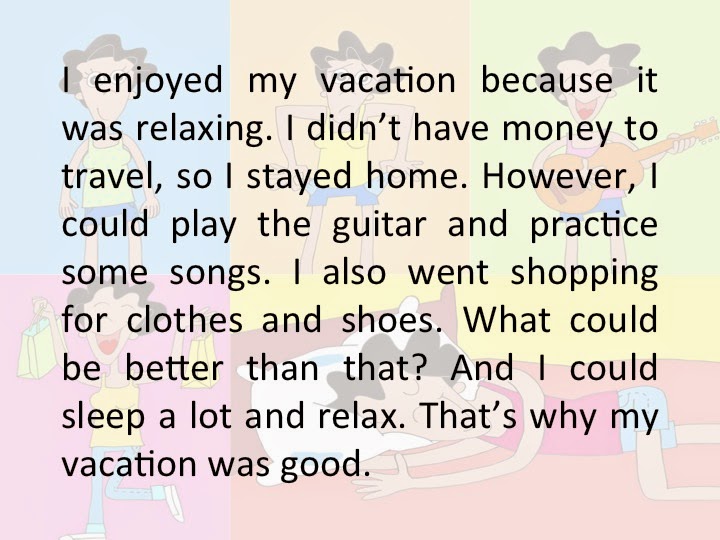
This is an opportunity for students to learn personal information about the teacher. The ultimate goal is to engage students into writing and make them familiar with simple writing techniques. Show students drawings of your last vacation. Don't worry if you don't draw well. The fact that you drew them will   encourage your students to do the same. Also, show short simple sentences for each drawing.  Make sure, students identify and understand the three parts of a paragraph:  


1) TOPIC SENTENCE: It tells you what the paragraph will be about;
2) BODY: It is developed around the topic sentence usually with examples and details;
3) CONCLUSION: It restates the introduction with different words.

Also, make sure students are familiar with "connectors". After showing your students your sentences, allow them some time to draw and write about their own vacation. Have colored pencils and blank sheets of paper available on your desk in case they don´t have those. You can also assign this task for homework. At home, they will scan and upload their drawings and write about them.  They can make a video or a power point slide presentation to show in the following class.

I enjoyed my vacation because it was relaxing.

I didn't have money to travel, so I stayed in Brasilia.

However, I could play the guitar and practice some songs.

I went shopping for clothes and shoes.

And I could sleep a lot and relax.


Show your students what a paragraph should look like:


Sunday, August 10, 2014

My Best Friend

After learning how to describe people´s physical characteristics, my students have been asked to draw, color and write about their best friends.

Tuesday, May 6, 2014

How old are you?

Super simple activity for practicing HOW OLD ARE YOU? with elementary students. I usually draw first to demonstrate what I expect from them.


  Teacher´s                                 Student´s


1) Write the following on the board:

HOW OLD ARE YOU? I´m___________

2) Hand out sheets in blank;
3) Students draw and color their age (They draw a big number in the center of the sheet)
4) Students tape them on their chest;
5) Students walk around the classroom and practice Q/A;

Saturday, January 11, 2014

Let's go to the zoo

My students learned how to describe animals' physical characteristics and abilities. The structure  learned here was the verbs HAVE and BE. Among other words, they learned MANE, STRIPES, SPOTS, FEATHERS, TAIL, SCALES, FINS, HORNS, FUR, WHISKERS, TRUNK, WINGS,TEETH. Here is a fun task designed to consolidate the structure and vocabulary: 

1) Students drew, colored and cut out their favorite animal. (In order to prevent too many students from drawing the same animal, which is likely to happen, you can write the animals' names in slips and have students to draw one. That would also prevent arguments among them.) 

2) After they finished their animals, they taped them to brown pieces of paper and taped them to the board. 

3) We played a game.

Option 1- Q/A Practice: Students individually go to the board, point at an animal and asks a peer "What DO lions look like?" or "What DOES a lion look like?" or "What does THIS butterfly look like?" Yes/No questions can also be practiced such as "Do lions have a long tail?" 

Option 2 - Hot Potato: Students sit in a circle. When the music stops, the student with the ball answers a question based on the cut outs. There can also be two balls, one for the question and one for the answer. (Another option is to simply say a sentence such as "Lions have… or Lions are… or Lions can...". ) 

Option 3 - The Wacky Race


Friday, January 10, 2014

What's there in your island?

After learning the verb THERE TO BE, my students drew an island and described it by using the vocabulary learned (Volcano/ Forest/River/Waterfall/Beach/Valley/Mountain/Lake)


OPTION 2: The Island Song 

Thursday, November 21, 2013

My favorite singer

Students are learning how to describe their talents. After practicing the structure " I can... but I can´t ..." and learning the names of the musical instruments, I assigned the following written task: Draw and color you favorite singer and write about him/her.


Sunday, November 10, 2013

Bugs Here, There and Everywhere


Students learned the names of the BUGS and the verb THERE TOBE to describe their garden. After we practiced the affirmative, negative and interrogative forms for a few classes, they drew, color and cut out one bug each. I taped them all on the board and told them to pay attention to the number and the colors of the bugs . I invited one student at a time to go to the front (facing their peers and not the board) and guess how many of each bug there were and how many of a certain color. For instance, I asked: How many SPIDERS are there? or "How many RED spiders are there?" or Are there any PURPLE snakes?

OPTION 2: Students can also be the ones to ask the questions, so the teacher could arrange them in two teams.


Writing Task: After practicing the verb THERE TO BE and the names of the bugs, my students were asked to draw their own yard and write about it. They were supposed to use THERE TO BE and the names of the bugs.


Saturday, November 9, 2013

His X Her

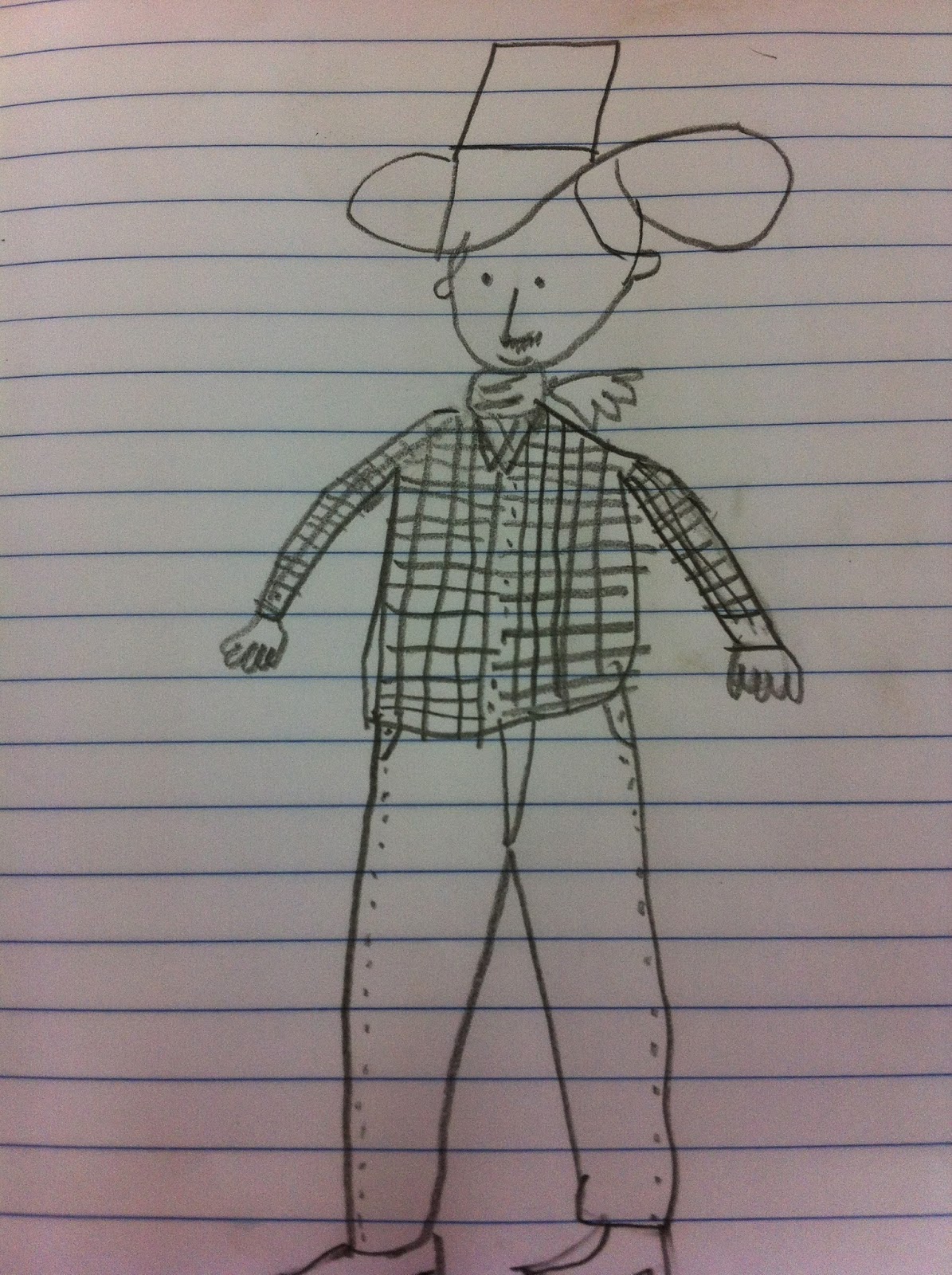
Students this semester drew a cowboy/cowgirl to describe their clothes by using HIS or HER, CLOTHES and COLORS.  First, I drew a cowboy as a model. Then, I took photos of their cowboys while they were drawing them and after they all had finished, I took a photograph of each and showed them on the data show equipment, so they described them. They were supposed to use: His pants are...., his scarf is... his shirt is... his boots are... and his hat is...  

Model


Friday, October 25, 2013

My Super Duper Costume

I went shopping today and tried on some cool costumes but it took me a while to finally find the right one. I hope you like it as much as I did. It fits me like a glove!

Photocopiable Material

Tuesday, September 24, 2013

Landscapes

My little ones learned vocabulary related to an island and how to describe it by using the verb THERE TO  BE. They drew a landscape and described it.

Monday, September 23, 2013

Family Members - Option 2

After practicing the family members and how to introduce them, students are given sheets of paper and instructed to fold them and draw the members of their family. Some students have very big families, so instruct them to draw just the ones that live with them. Afterwards, they write about them using the structure learned.

Step 1: FOLD

The number of folded parts will depend on the number of people in the student's family. (Sometimes, it is very difficult for them to fold the sheet, so you can do it for them. Ask them how many people they have in their family and fold it accordingly.)


Step 2: DRAW

It is only necessary to draw one on the first rectangle. (Point out that the ends of the arms and legs have to touch the edges of the sheet. )


Step 3: CUT OUT 

Students cut it out. (This step may be even more difficult than folding, so you might need to cut a few in order for them not to wreck it.)


Step 4: DRAW AND COLOR THE DETAILS

Students draw and color the details of each member in their family 


In the end, give each student a colored sheet of paper. Students paste their family and write about them. Collect and display them on the walls. You can also digitize their work, so their parents can see it.

Friday, September 20, 2013

Wacky Race - Option 2

This activity is suitable for children after they practice describing wild animals (abilities and physical characteristics). Students are given a sheet of paper in blank. Each student draws, colors and cuts out a different animal of their preference. After all students finish cutting out their animals , take them to a large place (in case the classroom is not big enough) and use duct tape to make a start and a finish line on the floor. Students sit behind the start line and wait for the teacher's command ('This animal has beautiful feathers', 'This animal can run fast', 'This animal has a long trunk', etc...). The students whose animals' characteristics match the commands blow their animal on the floor so it moves forward (Yes, they can´t use their hands). Tell students that they can only blow the animal once for each command, otherwise they are disqualified. The winner is the student whose animal reaches the finish line first.

Friday, September 13, 2013

How's the weather today?

Dani Lyra needed illustrations for a reading activity with her little ones, so she asked me to draw pictures of different kinds of weather. Here they are.
Images - Downloadable

Monday, September 9, 2013

My Super Duper Pets

I used this activity to practice describing pets, their names and colors. After that, students drew their own pet and wrote about them. Super Duper loves animals and so do his friends. Here they are.

Activity proposed for these images