After learning how to describe people´s physical characteristics, my students have been asked to draw, color and write about their best friends.
Showing posts with label Vocabulary. Show all posts
Showing posts with label Vocabulary. Show all posts
Sunday, August 10, 2014

Monday, January 13, 2014
Happy Birthday!
After being introduced to vocabulary related to birthdays (gifts, party, cake, balloons, and names of toys) my students also learned to congratulate someone for their birthday and how to ask Yes/No questions with the verb TO BE.
S1: Happy Birthday!
S2: Thanks.
S1: This is for you. (a gift)
S2: Thank you very much! Is it a …….?
S1: Yes, it is.
S2: Thanks.
S1: This is for you. (a gift)
S2: Thank you very much! Is it a …….?
S1: No, it isn't. It's a ………
After being presented to the dialog and practicing for a while, my students were given a sheet in blank.
1) They folded their sheet in two.
2) They drew and colored ( ON THE INSIDE) a gift they would like to get for their birthday or a gift they have received for their birthday.
3) Then, they drew a gift like picture ON THE OUTSIDE of the paper. (wrapping paper patterned and a ribbon)
4) Monitor students, so you have an idea of the gifts there are because later on, they will exchange their gifts. Thus, it's important to mentally arrange them in pairs in a way everyone receives an appropriate gift.
5) After that, I chose the pairs and called them out and two by two, they acted out the conversation above and exchanged their gifts. Remember that during the dialog, they have to guess what the gift is by asking "Is it a ….?" In case the student doesn't guess it at all, you can encourage students to ask "What is it?" In my class, there was one student alone, so I participated by drawing one gift myself. During the dialog, students exchanged their gifts and sat down.
6) In the end, they glued their gift drawing to their notebooks and wrote a thank you letter.

Saturday, January 11, 2014
Let's go to the zoo
My students learned how to describe animals' physical characteristics and abilities. The structure learned here was the verbs HAVE and BE. Among other words, they learned MANE, STRIPES, SPOTS, FEATHERS, TAIL, SCALES, FINS, HORNS, FUR, WHISKERS, TRUNK, WINGS,TEETH. Here is a fun task designed to consolidate the structure and vocabulary:
1) Students drew, colored and cut out their favorite animal. (In order to prevent too many students from drawing the same animal, which is likely to happen, you can write the animals' names in slips and have students to draw one. That would also prevent arguments among them.)
2) After they finished their animals, they taped them to brown pieces of paper and taped them to the board.
3) We played a game.
Option 1- Q/A Practice: Students individually go to the board, point at an animal and asks a peer "What DO lions look like?" or "What DOES a lion look like?" or "What does THIS butterfly look like?" Yes/No questions can also be practiced such as "Do lions have a long tail?"
Option 2 - Hot Potato: Students sit in a circle. When the music stops, the student with the ball answers a question based on the cut outs. There can also be two balls, one for the question and one for the answer. (Another option is to simply say a sentence such as "Lions have… or Lions are… or Lions can...". )
Option 3 - The Wacky Race


Friday, January 10, 2014
What's there in your island?
After learning the verb THERE TO BE, my students drew an island and described it by using the vocabulary learned (Volcano/ Forest/River/Waterfall/Beach/Valley/Mountain/Lake)


OPTION 2: The Island Song
Super Duper Worth it

Boo hoo! Vacation is over and we're on our way back to Brazil. Although many people think traveling is more exhausting than relaxing, I think otherwise. Traveling and being able to meet different people and see different places is totally worth it! It's worth the twelve-hour flight and other little inconveniences such as the freezing weather. I'll have wonderful memories and stories to tell.
The activities below have as a final outcome 'writing about your last vacation'.
Suggestions for ActivitiesThe activities below have as a final outcome 'writing about your last vacation'.
Saturday, January 4, 2014
Drawing Dictation
Age: Children
Focus: Vocabulary Practice
This is a super simple activity. I usually do it as a warm up after students have practiced ANY vocabulary presented. It consists in dictating the words and having students draw them. They have a laugh! As they draw them, you can tell whether they understand the vocabulary or not. Another option here is to have students draw them in their notebooks instead. You can also dictate the colors. For instance: "Draw a ladybug and color it red and black" (to make the task more fun, you can say different colors, instead.)

Centipede

Ladybyg

Spider

Butterfly

Beetle
Thursday, December 19, 2013
Board Game Project
Despite all the technology available in the classrooms (iPads, data show equipment, computer labs, etc…) I still think that drawing, coloring and cutting out are fun. Also, the project below promotes collaboration/ cooperation among students. My Junior students were learning the affirmative, negative and interrogative forms of the verb THERE TO BE. After some significant practice and in order to wrap the lesson up, students were arranged in small groups (3 or 4 tops) and I assigned a different task for each member.
MATERIAL NEEDED: Brown paper, magazines, glue, markers, colored pencils and scissors.
BOARD GAME
MATERIAL NEEDED: Brown paper, magazines, glue, markers, colored pencils and scissors.
FOCUS: Any Grammar Point or Vocabulary Practice.
Student A: Selects and cuts out pictures from the magazines.
Student B: Draws and colors a START/FINISH track on the brown paper.
Student C: Creates the tasks to be performed in the game. (Assisted by the teacher/peers.)
Student D: Pastes the cut outs. (In case the group has three students, student A selects, cuts out and pastes the pictures.)
Possible tasks to be performed when playing the game:
1) Fill in a blank:
(For instance, in one of the squares, you see the picture of a cat on the couch and you read: Is there a cat on the couch? Yes, ________. Or: ____________a cat on the couch? Yes, there is.)
2) Answer a question:
What is there in the picture?________________________.
Are there any cars in the picture?__________________________.
3) Ask a question:
__________________________? Yes, there is.
________________________? No, there aren´t.
4) Correct the mistake.
There is three children in the picture.
There is a dog in the picture?


The teacher has to make sure (and students should be told that) that during the entire time that they are performing their tasks, they should discuss every decision they make with their peers and collaborate with each other whenever necessary. After they finish making the game, they play it.
In the end, the teacher can have the board games laminated for future classes.

Sunday, November 10, 2013
Bugs Here, There and Everywhere

Students learned the names of the BUGS and the verb THERE TOBE to describe their garden. After we practiced the affirmative, negative and interrogative forms for a few classes, they drew, color and cut out one bug each. I taped them all on the board and told them to pay attention to the number and the colors of the bugs . I invited one student at a time to go to the front (facing their peers and not the board) and guess how many of each bug there were and how many of a certain color. For instance, I asked: How many SPIDERS are there? or "How many RED spiders are there?" or Are there any PURPLE snakes?
OPTION 2: Students can also be the ones to ask the questions, so the teacher could arrange them in two teams.
Writing Task: After practicing the verb THERE TO BE and the names of the bugs, my students were asked to draw their own yard and write about it. They were supposed to use THERE TO BE and the names of the bugs.

Saturday, November 9, 2013
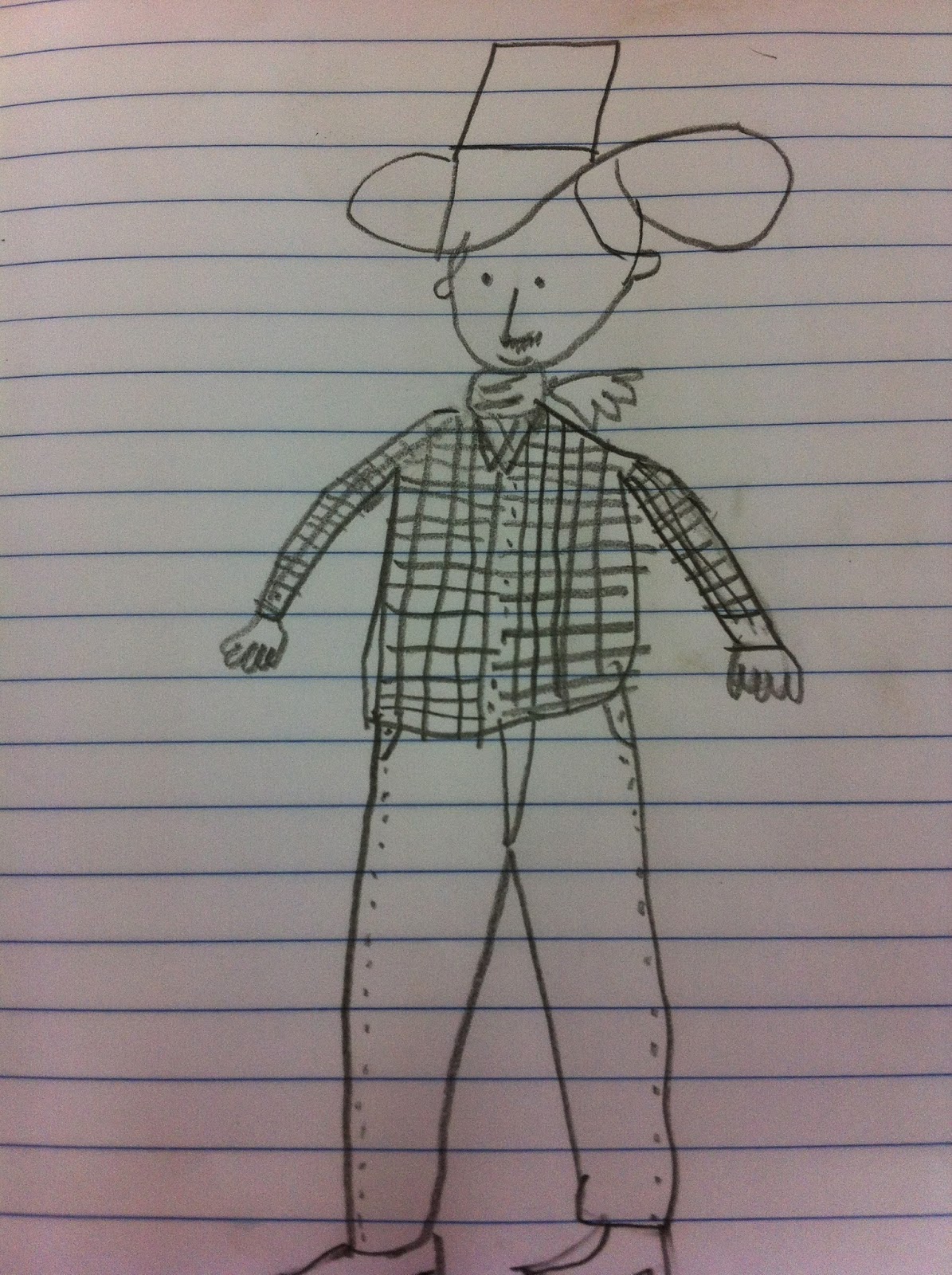
His X Her
Students this semester drew a cowboy/cowgirl to describe their clothes by using HIS or HER, CLOTHES and COLORS. First, I drew a cowboy as a model. Then, I took photos of their cowboys while they were drawing them and after they all had finished, I took a photograph of each and showed them on the data show equipment, so they described them. They were supposed to use: His pants are...., his scarf is... his shirt is... his boots are... and his hat is...

Model




Saturday, October 5, 2013
Yawning...Frowning

An adult student during a reading activity:
"Teacher, what's yawning and frowning?"
Wednesday, October 2, 2013
Instructions for Children
Whenever I assign a task in which students have to write/draw, color, cut out and paste, I draw on the board the following sequence:


Friday, September 27, 2013
Brazil in the World Cup Finals in 1994
The activity below was designed as a final project for a course I took in 2009 called "WEBTOOLS FOR EDUCATORS" and conducted by Carla Arena. The goal was to make an advanced group of students interested and prepared to talk about the topic, which was soccer. In order to make that happen, they were presented vocabulary related to soccer and a video with drawings I had made. The ultimate task was to write about a soccer game they had watched, using the vocabulary learned.
Tuesday, September 24, 2013
Landscapes
My little ones learned vocabulary related to an island and how to describe it by using the verb THERE TO BE. They drew a landscape and described it.
Monday, September 23, 2013
Family Members - Option 2
After practicing the family members and how to introduce them, students are given sheets of paper and instructed to fold them and draw the members of their family. Some students have very big families, so instruct them to draw just the ones that live with them. Afterwards, they write about them using the structure learned.
Step 1: FOLD

Step 2: DRAW


Step 1: FOLD
The number of folded parts will depend on the number of people in the student's family. (Sometimes, it is very difficult for them to fold the sheet, so you can do it for them. Ask them how many people they have in their family and fold it accordingly.)
Step 2: DRAW
It is only necessary to draw one on the first rectangle. (Point out that the ends of the arms and legs have to touch the edges of the sheet. )
Step 3: CUT OUT
Students cut it out. (This step may be even more difficult than folding, so you might need to cut a few in order for them not to wreck it.)
Step 4: DRAW AND COLOR THE DETAILS
Students draw and color the details of each member in their family
In the end, give each student a colored sheet of paper. Students paste their family and write about them. Collect and display them on the walls. You can also digitize their work, so their parents can see it.
Saturday, September 21, 2013
Daily Routine
To introduce the lesson, which is about daily routine, I arranged students in pairs and showed them the images below. They discussed for awhile and after that I elicited the activities that the images represented.

GET UP
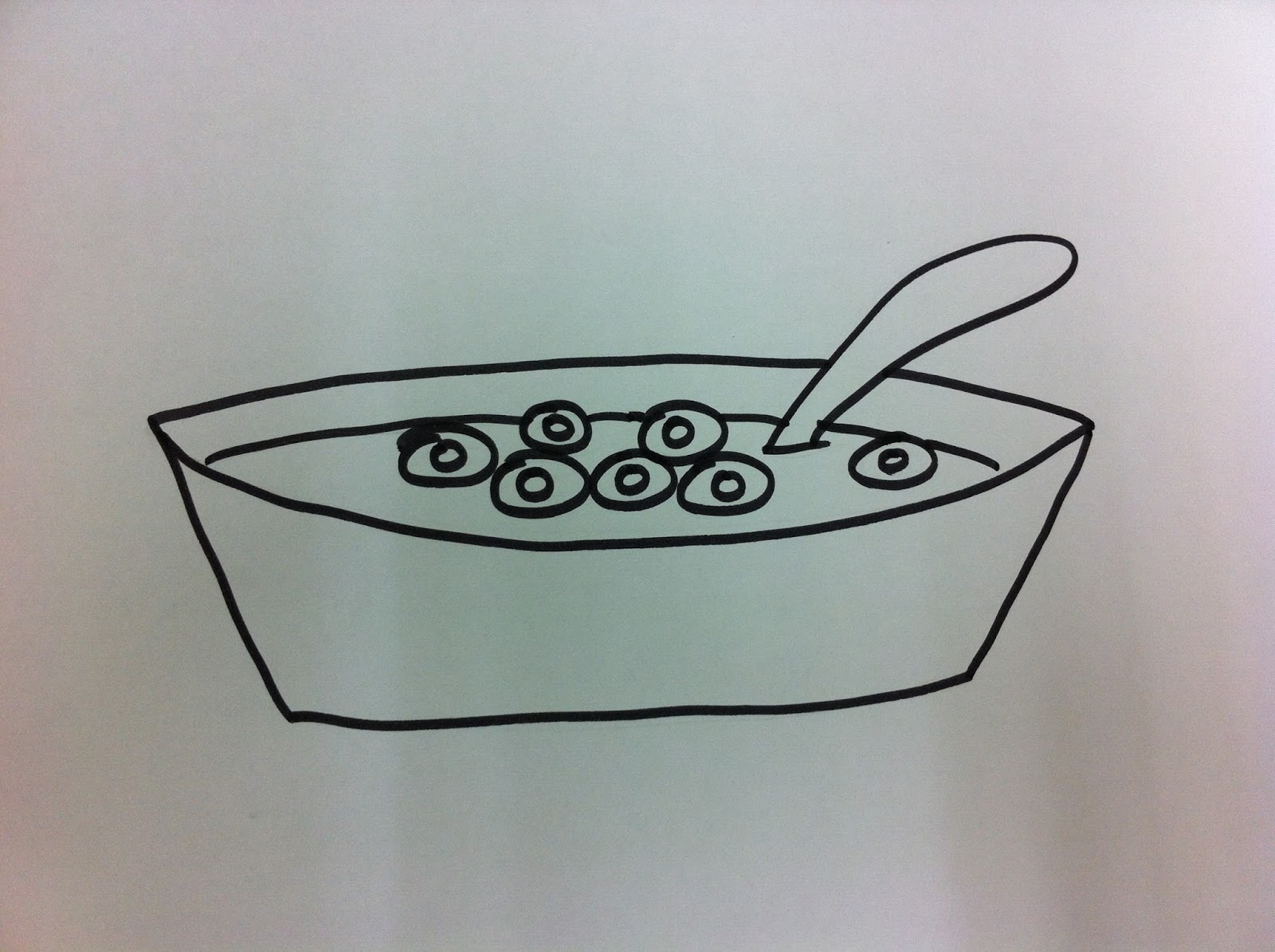
HAVE BREAKFAST

GO TO SCHOOL

HAVE LUNCH

GO HOME

DO HOMEWORK

GO TO BED
OPTION 2: Instead of showing students the images, divide them in two teams and name one member of each team to draw the activities on the board. Have the names of the activities on small slips of paper and put them in a can. Then, the student in team A draws three slips from the can. He draws the activities and the team has to guess. The same thing with team B. The student draws the remaining slips from the can. He draws the activities and the team guesses what they are. Time the two teams during the task. The winner is the team that guessed the activities in a shorter period of time. In the end, elicit what the activities have in common. (They are daily activities).In the end, elicit what students do every day.
Friday, September 20, 2013
Wacky Race - Option 2
This activity is suitable for children after they practice describing wild animals (abilities and physical characteristics). Students are given a sheet of paper in blank. Each student draws, colors and cuts out a different animal of their preference. After all students finish cutting out their animals , take them to a large place (in case the classroom is not big enough) and use duct tape to make a start and a finish line on the floor. Students sit behind the start line and wait for the teacher's command ('This animal has beautiful feathers', 'This animal can run fast', 'This animal has a long trunk', etc...). The students whose animals' characteristics match the commands blow their animal on the floor so it moves forward (Yes, they can´t use their hands). Tell students that they can only blow the animal once for each command, otherwise they are disqualified. The winner is the student whose animal reaches the finish line first.

Subscribe to:
Posts (Atom)