Showing posts with label Grammar. Show all posts

Thursday, December 19, 2013

Board Game Project

Despite all the technology available in the classrooms (iPads, data show equipment, computer labs, etc…) I still think that drawing, coloring and cutting out are fun. Also, the project below promotes collaboration/ cooperation among students. My Junior students were learning the affirmative, negative and interrogative forms of the verb THERE TO BE. After some significant practice and in order to wrap the lesson up, students were arranged in small groups (3 or 4 tops) and I assigned a different task for each member.


BOARD GAME

MATERIAL NEEDED: Brown paper, magazines, glue, markers, colored pencils and scissors.
FOCUS: Any Grammar Point or Vocabulary Practice.


Student A: Selects and cuts out pictures from the magazines.
Student B: Draws and colors a START/FINISH track on the brown paper.
Student C: Creates the tasks to be performed in the game. (Assisted by the teacher/peers.)
Student D: Pastes the cut outs. (In case the group has three students, student A selects, cuts out and pastes the pictures.)

Possible tasks to be performed when playing the game:

1) Fill in a blank:

(For instance, in one of the squares, you see the picture of a cat on the couch and you read:  Is there a cat on the couch? Yes, ________. Or: ____________a cat on the couch? Yes, there is.)

2) Answer a question:

What is there in the picture?________________________. 
Are there any cars in the picture?__________________________.

3) Ask a question:

__________________________? Yes, there is.
________________________? No, there aren´t.

4) Correct the mistake.

There is three children in the picture.
There is a dog in the picture?


The teacher has to make sure (and students should be told that) that during the entire time that they are performing their tasks, they should discuss every decision they make with their peers and collaborate with each other whenever necessary. After they finish making the game, they play it.


In the end, the teacher can have the board games laminated for future classes.

Saturday, November 9, 2013

His X Her

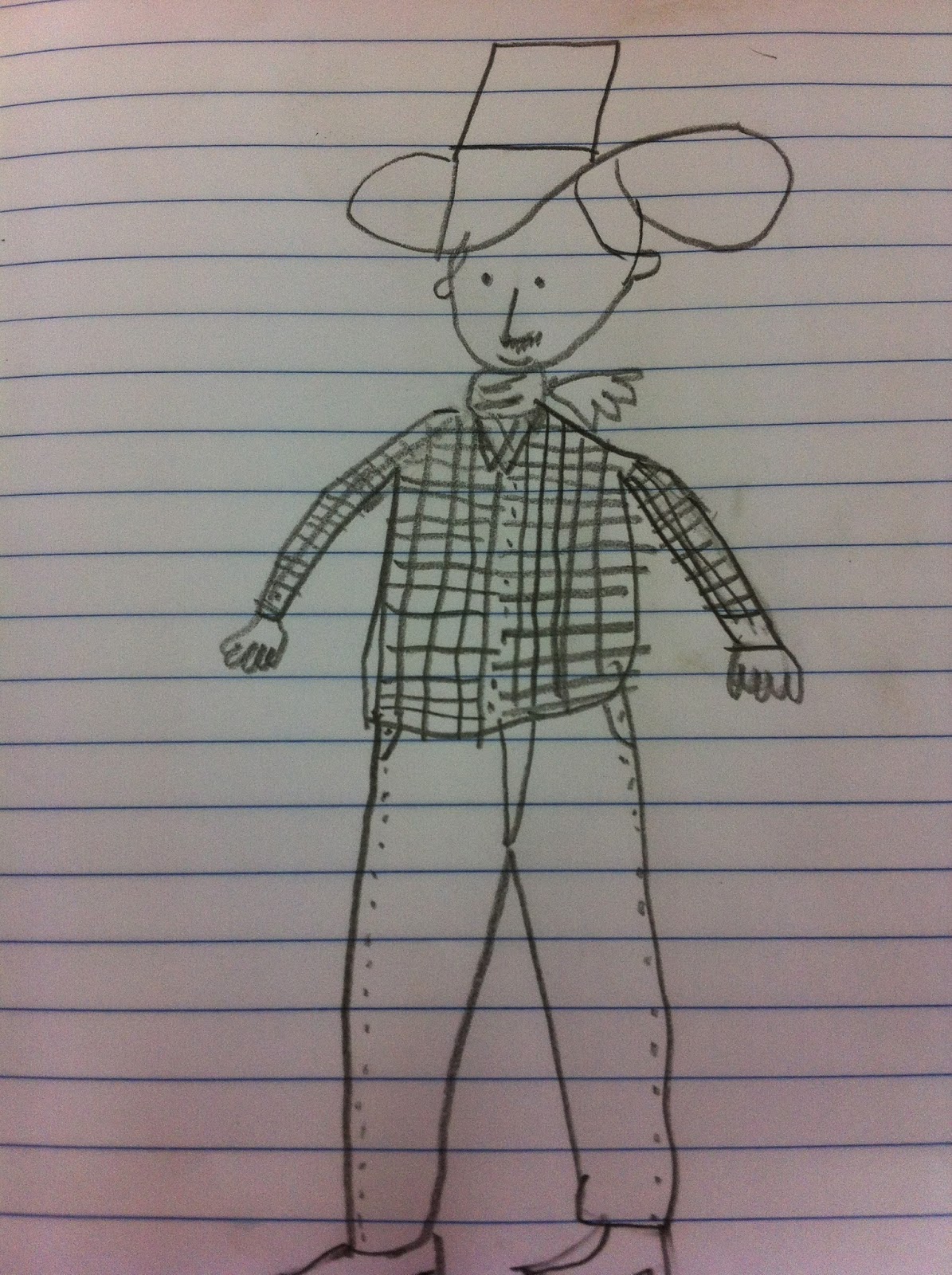
Students this semester drew a cowboy/cowgirl to describe their clothes by using HIS or HER, CLOTHES and COLORS.  First, I drew a cowboy as a model. Then, I took photos of their cowboys while they were drawing them and after they all had finished, I took a photograph of each and showed them on the data show equipment, so they described them. They were supposed to use: His pants are...., his scarf is... his shirt is... his boots are... and his hat is...  

Model


Saturday, October 26, 2013

Story Telling: Simple Past X Present Perfect

Dani Lyra, my dear colleague, asked me to draw a story to teach the Simple Past and the Present Perfect. A story in which these two tenses would be the main characters. Here is the thing: At first I thought I could record my voice telling the story, which I did, but afterwards I realized it would be more interesting to write the story, so you could memorize it and tell it yourself. Believe me, it's a lot more fun!  


Simple Past and Present Perfect were friends when they were little. They played, laughed and had a lot of fun together.

Eventually, Simple Past became a cowboy.

Present Perfect became a surfer.

Simple Past is very likable, straightforward, easy to understand.

Present Perfect is not easy to understand.

 Sometimes some people prefer to think he doesn't exist.

 Some frown at and look down on him.

And many people have misconceptions about him...

 ...which makes him upset.

 Simple Past is super attached to the past.

Every time he tells you about something he did, he will tell you "when". 

 And if you tell him that you traveled on your vacation, he will ask you when. And he will always use DID in questions.

Present Perfect has an eye in the present. 

Simple Past is obsessed about time...

...whereas Present Perfect doesn't even have a watch. He doesn't care when something happened. Sometimes it's because he doesn't remember.

Present Perfect always uses HAVE and the participle of a verb.

In questions, too.

 He uses HAS for the third person.

All these differences made them go separate ways, but it doesn't mean they are alone.

Simple Past has friends that hang out with and enjoy his company. They are always together.

Although some people don't understand Present Perfect, he has friends, too. Loyal friends who relate to him and are always there for him.


Friday, September 20, 2013

Wacky Race - Option 2

This activity is suitable for children after they practice describing wild animals (abilities and physical characteristics). Students are given a sheet of paper in blank. Each student draws, colors and cuts out a different animal of their preference. After all students finish cutting out their animals , take them to a large place (in case the classroom is not big enough) and use duct tape to make a start and a finish line on the floor. Students sit behind the start line and wait for the teacher's command ('This animal has beautiful feathers', 'This animal can run fast', 'This animal has a long trunk', etc...). The students whose animals' characteristics match the commands blow their animal on the floor so it moves forward (Yes, they can´t use their hands). Tell students that they can only blow the animal once for each command, otherwise they are disqualified. The winner is the student whose animal reaches the finish line first.

Wednesday, September 18, 2013

Wacky Race

Material needed: A die, sheets in blank, duct tape and colored pencils/markers. 


I do this activity with all levels. I give each team a sheet in blank so they can draw, color and cut out a car. I draw a race track on the board and tape the cars to it. I also draw a couple of bombs on the way. Then, I ask students questions about the lesson learned or show them sentences to be completed or questions about vocabulary. In other words, any task related to the content. Students take turns performing the task proposed. If the team is right, they roll a die and move their car. If they stop at the bomb, they go back to the starting point. The winner is the car that reaches the finish line first. Once the game is over, I collect the cars but I do not throw them away. I tape them to the wall, so I can use them again in the future.


Once the game is over, I collect the cars but I do not throw them away. I tape them to the wall, so I can use them again in a future activity.