Super Duper is a teenager and he lives with his parents, who are loving parents and who are always there for him.
Images - Downloadable
Showing posts with label Young Learners. Show all posts
Showing posts with label Young Learners. Show all posts
Sunday, December 28, 2014

Sunday, August 10, 2014
My Best Friend
After learning how to describe people´s physical characteristics, my students have been asked to draw, color and write about their best friends.
Tuesday, May 6, 2014
How old are you?
Super simple activity for practicing HOW OLD ARE YOU? with elementary students. I usually draw first to demonstrate what I expect from them.


1) Write the following on the board:
HOW OLD ARE YOU? I´m___________
2) Hand out sheets in blank;
3) Students draw and color their age (They draw a big number in the center of the sheet)
4) Students tape them on their chest;
5) Students walk around the classroom and practice Q/A;
Teacher´s Student´s
1) Write the following on the board:
HOW OLD ARE YOU? I´m___________
2) Hand out sheets in blank;
3) Students draw and color their age (They draw a big number in the center of the sheet)
4) Students tape them on their chest;
5) Students walk around the classroom and practice Q/A;
Monday, January 13, 2014
Happy Birthday!
After being introduced to vocabulary related to birthdays (gifts, party, cake, balloons, and names of toys) my students also learned to congratulate someone for their birthday and how to ask Yes/No questions with the verb TO BE.
S1: Happy Birthday!
S2: Thanks.
S1: This is for you. (a gift)
S2: Thank you very much! Is it a …….?
S1: Yes, it is.
S2: Thanks.
S1: This is for you. (a gift)
S2: Thank you very much! Is it a …….?
S1: No, it isn't. It's a ………
After being presented to the dialog and practicing for a while, my students were given a sheet in blank.
1) They folded their sheet in two.
2) They drew and colored ( ON THE INSIDE) a gift they would like to get for their birthday or a gift they have received for their birthday.
3) Then, they drew a gift like picture ON THE OUTSIDE of the paper. (wrapping paper patterned and a ribbon)
4) Monitor students, so you have an idea of the gifts there are because later on, they will exchange their gifts. Thus, it's important to mentally arrange them in pairs in a way everyone receives an appropriate gift.
5) After that, I chose the pairs and called them out and two by two, they acted out the conversation above and exchanged their gifts. Remember that during the dialog, they have to guess what the gift is by asking "Is it a ….?" In case the student doesn't guess it at all, you can encourage students to ask "What is it?" In my class, there was one student alone, so I participated by drawing one gift myself. During the dialog, students exchanged their gifts and sat down.
6) In the end, they glued their gift drawing to their notebooks and wrote a thank you letter.

Saturday, January 11, 2014
Let's go to the zoo
My students learned how to describe animals' physical characteristics and abilities. The structure learned here was the verbs HAVE and BE. Among other words, they learned MANE, STRIPES, SPOTS, FEATHERS, TAIL, SCALES, FINS, HORNS, FUR, WHISKERS, TRUNK, WINGS,TEETH. Here is a fun task designed to consolidate the structure and vocabulary:
1) Students drew, colored and cut out their favorite animal. (In order to prevent too many students from drawing the same animal, which is likely to happen, you can write the animals' names in slips and have students to draw one. That would also prevent arguments among them.)
2) After they finished their animals, they taped them to brown pieces of paper and taped them to the board.
3) We played a game.
Option 1- Q/A Practice: Students individually go to the board, point at an animal and asks a peer "What DO lions look like?" or "What DOES a lion look like?" or "What does THIS butterfly look like?" Yes/No questions can also be practiced such as "Do lions have a long tail?"
Option 2 - Hot Potato: Students sit in a circle. When the music stops, the student with the ball answers a question based on the cut outs. There can also be two balls, one for the question and one for the answer. (Another option is to simply say a sentence such as "Lions have… or Lions are… or Lions can...". )
Option 3 - The Wacky Race


Friday, January 10, 2014
What's there in your island?
After learning the verb THERE TO BE, my students drew an island and described it by using the vocabulary learned (Volcano/ Forest/River/Waterfall/Beach/Valley/Mountain/Lake)


OPTION 2: The Island Song
Monday, January 6, 2014
What do they look like?
After my students learned how to describe themselves and their peers, we did a wrap up coloring activity. Each student was given a piece of brown paper, colored pencils and markers. First, they drew and colored themselves. After that, as they taped their drawings to the board, they described themselves using the structure learned, which is "I am… / I have….". During their description, make any necessary corrections in pronunciation. Then, they played a guessing game. I arranged them in two groups (boys X girls) and allowed them to practice the structure by referring to the drawings. For instance, a student from the boys' group said to a student in the girls' group "This student is.../has…, who is that?" After discussing with her team, if the girl answers the question correctly, the girls get the point. They take turns for awhile until they have practiced enough. The team with more points is the winner. Students can also ask "What does ____ look like?" (Make sure that they answer the questions by using "He is.../He has…")


Optional: Tic Tac Toe
In case there are 9 students or more, tape their drawings on the board as in a tic tac toe grid (three columns of three drawings each). As students describe the drawings correctly, tape cut outs of Xs or Os on them.
Saturday, January 4, 2014
Drawing Dictation
Age: Children
Focus: Vocabulary Practice
This is a super simple activity. I usually do it as a warm up after students have practiced ANY vocabulary presented. It consists in dictating the words and having students draw them. They have a laugh! As they draw them, you can tell whether they understand the vocabulary or not. Another option here is to have students draw them in their notebooks instead. You can also dictate the colors. For instance: "Draw a ladybug and color it red and black" (to make the task more fun, you can say different colors, instead.)

Centipede

Ladybyg

Spider

Butterfly

Beetle
Monday, December 23, 2013
My Super Duper Friends
After practicing the use of the third person in the Simple Present, students are to draw and write about their best friend.
Just like any other teenager, Super Duper also has his gang. They hang out and have fun together. Let's meet them:
Downloadable Material
Just like any other teenager, Super Duper also has his gang. They hang out and have fun together. Let's meet them:
Downloadable Material
Thursday, December 19, 2013
Board Game Project
Despite all the technology available in the classrooms (iPads, data show equipment, computer labs, etc…) I still think that drawing, coloring and cutting out are fun. Also, the project below promotes collaboration/ cooperation among students. My Junior students were learning the affirmative, negative and interrogative forms of the verb THERE TO BE. After some significant practice and in order to wrap the lesson up, students were arranged in small groups (3 or 4 tops) and I assigned a different task for each member.
MATERIAL NEEDED: Brown paper, magazines, glue, markers, colored pencils and scissors.
BOARD GAME
MATERIAL NEEDED: Brown paper, magazines, glue, markers, colored pencils and scissors.
FOCUS: Any Grammar Point or Vocabulary Practice.
Student A: Selects and cuts out pictures from the magazines.
Student B: Draws and colors a START/FINISH track on the brown paper.
Student C: Creates the tasks to be performed in the game. (Assisted by the teacher/peers.)
Student D: Pastes the cut outs. (In case the group has three students, student A selects, cuts out and pastes the pictures.)
Possible tasks to be performed when playing the game:
1) Fill in a blank:
(For instance, in one of the squares, you see the picture of a cat on the couch and you read: Is there a cat on the couch? Yes, ________. Or: ____________a cat on the couch? Yes, there is.)
2) Answer a question:
What is there in the picture?________________________.
Are there any cars in the picture?__________________________.
3) Ask a question:
__________________________? Yes, there is.
________________________? No, there aren´t.
4) Correct the mistake.
There is three children in the picture.
There is a dog in the picture?


The teacher has to make sure (and students should be told that) that during the entire time that they are performing their tasks, they should discuss every decision they make with their peers and collaborate with each other whenever necessary. After they finish making the game, they play it.
In the end, the teacher can have the board games laminated for future classes.

Thursday, November 21, 2013
My favorite singer
Students are learning how to describe their talents. After practicing the structure " I can... but I can´t ..." and learning the names of the musical instruments, I assigned the following written task: Draw and color you favorite singer and write about him/her.


Thursday, November 14, 2013
Getting Ready For Christmas: Going Through Christmas Stuff

Sunday, November 10, 2013
Bugs Here, There and Everywhere

Students learned the names of the BUGS and the verb THERE TOBE to describe their garden. After we practiced the affirmative, negative and interrogative forms for a few classes, they drew, color and cut out one bug each. I taped them all on the board and told them to pay attention to the number and the colors of the bugs . I invited one student at a time to go to the front (facing their peers and not the board) and guess how many of each bug there were and how many of a certain color. For instance, I asked: How many SPIDERS are there? or "How many RED spiders are there?" or Are there any PURPLE snakes?
OPTION 2: Students can also be the ones to ask the questions, so the teacher could arrange them in two teams.
Writing Task: After practicing the verb THERE TO BE and the names of the bugs, my students were asked to draw their own yard and write about it. They were supposed to use THERE TO BE and the names of the bugs.

Saturday, November 9, 2013
His X Her
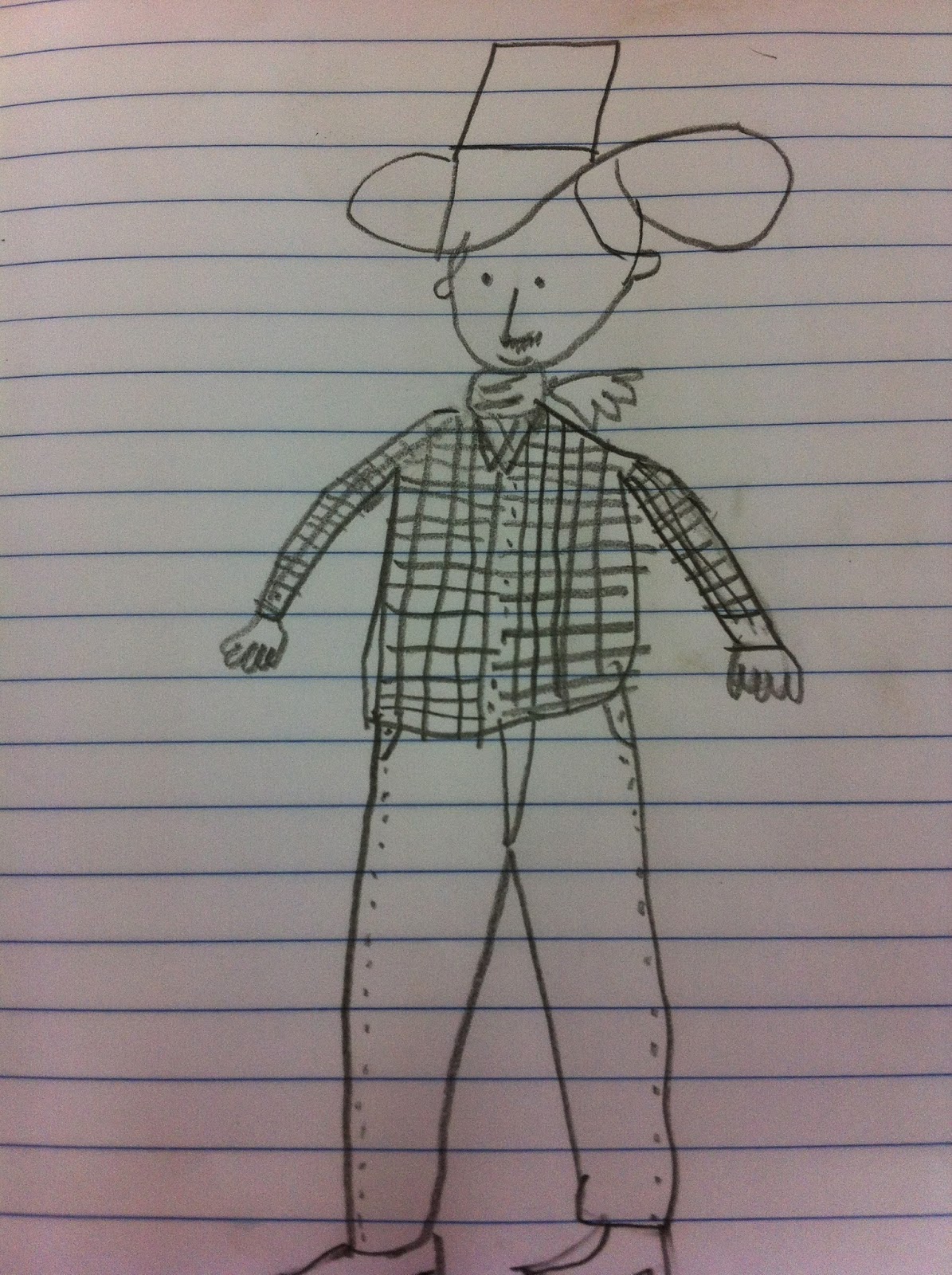
Students this semester drew a cowboy/cowgirl to describe their clothes by using HIS or HER, CLOTHES and COLORS. First, I drew a cowboy as a model. Then, I took photos of their cowboys while they were drawing them and after they all had finished, I took a photograph of each and showed them on the data show equipment, so they described them. They were supposed to use: His pants are...., his scarf is... his shirt is... his boots are... and his hat is...

Model




Friday, October 25, 2013
My Super Duper Costume
I went shopping today and tried on some cool costumes but it took me a while to finally find the right one. I hope you like it as much as I did. It fits me like a glove!
Photocopiable Material
Photocopiable Material
Friday, October 18, 2013
The Fridge Song
This activity has been designed for a group of children. The grammar focus here was the verb THERE TOBE.
STEP 1: First, students draw what they have in their fridges. (Teachers can use a data show equipment so they can share their drawings with peers)


STEP 2: Students guess what the teacher has in his/her fridge. The teacher projects a photo of his/her fridge, so students check whether they were right.

STEP 3: Students listen to "THE FRIDGE SONG".
STEP 4: The powerpoint presentation provided for the activity allows students to write their own version of the song, so they are arranged in small groups and work on what food items they will use in it. When they finish, they write their version of the song on the board.


STEP 5: Finally, they share their song with all their peers.
Activity - Downloadable
P.S. Steps 1 and 2 are interchangeable.
COOL TIP:
A nice activity to be done in the following day is:
1) Arrange students in two teams.
2) Project the images of the students' fridges' drawings and give them 1 minute to memorize them.
3) Ask them questions using IS THERE ANY...? and ARE THERE ANY...?
Subscribe to:
Posts (Atom)